Integrating document processing capabilities is crucial for enhancing user experience in many web applications, allowing for efficient report generation and data handling. React, with its component-based architecture, is an excellent choice for frontend development. By integrating Spire.Doc for JavaScript, you can effortlessly create and manage Word documents within your React application.
This guide will walk you through the steps to integrate Spire.Doc for JavaScript into your React projects, covering both setup and a usage example.
- Benefits of Using Spire.Doc for JavaScript in React
- Set Up Your Environment
- Integrate Spire.Doc for JavaScript in Your Project
- Create and Save Word Files Using JavaScript
Benefits of Using Spire.Doc for JavaScript in React
React, a popular JavaScript library for building user interfaces, has become a cornerstone in modern web development. On the other hand, Spire.Doc for JavaScript is a powerful library designed to simplify document processing in web applications.
By integrating Spire.Doc for JavaScript into your React project, you can add advanced Word document processing capabilities to your application. Here are some of the key advantages:
- Seamless Document Creation: Spire.Doc for JavaScript enables document creation and editing directly in React, streamlining management without external tools.
- Cross-Platform Compatibility: Spire.Doc for JavaScript allows document creation compatible with multiple platforms, enabling users to access and edit documents from anywhere.
- Rich Features: Spire.Doc for JavaScript offers extensive capabilities like text formatting, table creation, and image insertion, ideal for applications needing document manipulation.
- Seamless Integration: Compatible with various JavaScript frameworks, including React, Spire.Doc for JavaScript integrates easily into existing projects without disrupting your workflow.
Set Up Your Environment
Step 1. Install React and npm
Download and install Node.js from the official website. Make sure to choose the version that matches your operating system.
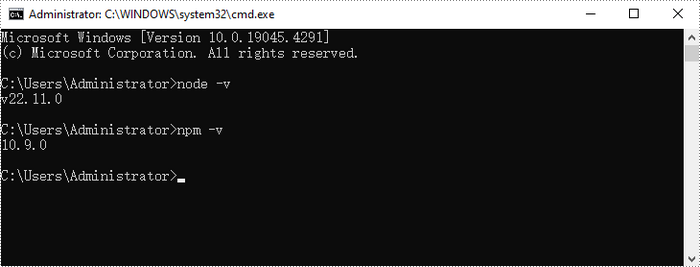
After the installation is complete, you can verify that Node.js and npm are working correctly by running the following commands in your terminal:
Step 2. Create a New React Project
Create a new React project named my-app using Create React App from terminal:
npx create-react-app my-app
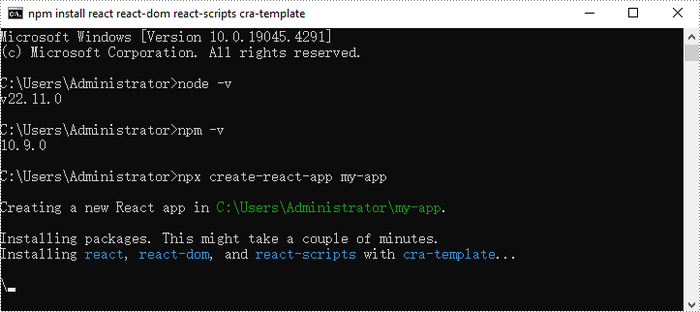
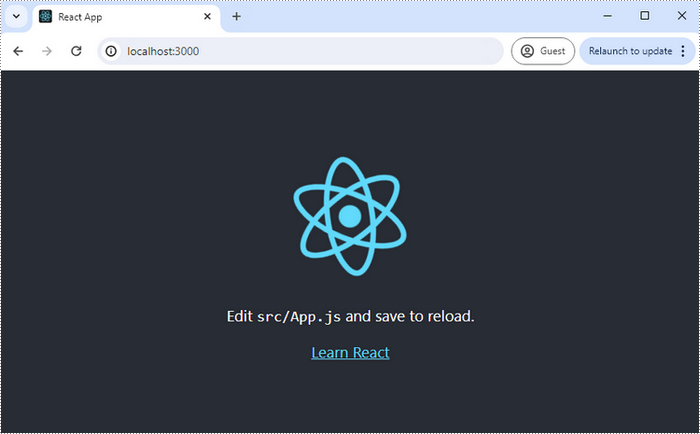
If your React project is compiled successfully, the app will be served at http://localhost:3000, allowing you to view and test your application in a browser.
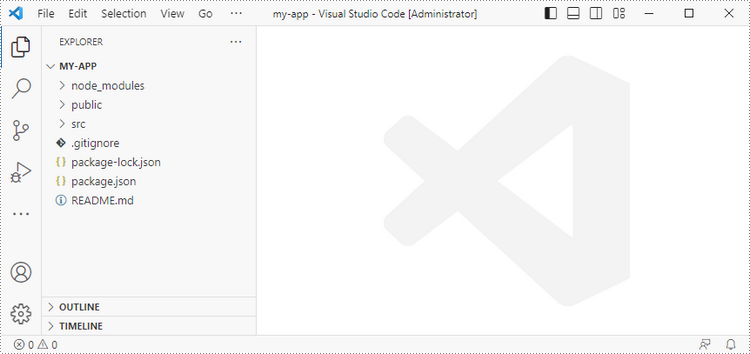
To visually browse and manage the files in your project, you can open the project using VS Code.
Integrate Spire.Doc for JavaScript in Your Project
Download Spire.Doc for JavaScript from our website and unzip it to a location on your disk. The downloaded product package integrates Spire.Doc for JavaScript, Spire.XLS for JavaScript, Spire.PDF for JavaScript, and Spire.Presentation for JavaScript. To use the features of Spire.Doc for JavaScript, you need to copy the corresponding files (spire.doc.js, Spire.Doc.Wasm.zip, spire.common.js, Spire.Common.Wasm.zip, and the _framework folder) to the public folder of your project.
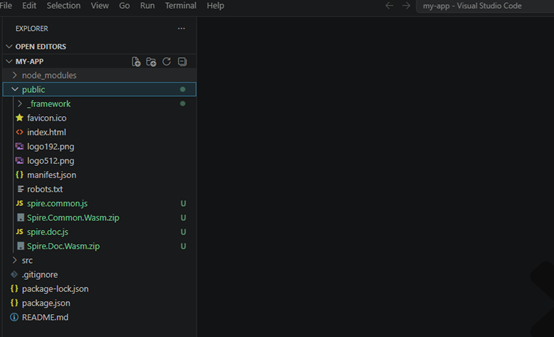
You can also install using npm. In the terminal within VS Code, run the following command:
npm i spire.officeOnce the installation is complete, the product package files will be saved in the node_modules/spire.office path of your project. Copy the 5 files mentioned above into the "public" folder in your React project.
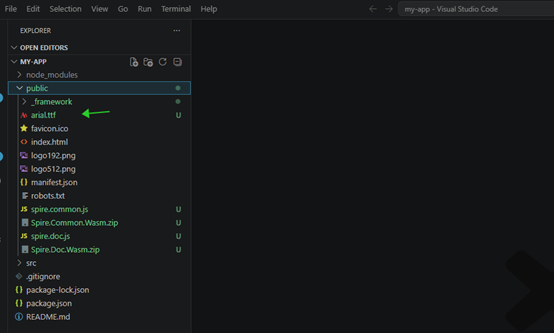
To ensure proper text rendering, you can add relevant font files with a custom path. In the following example, the font is added to the path: public\.
Create and Save Word Files Using JavaScript
Modify the code in the "App.js" file to generate a Word file using the WebAssembly (WASM) module. Specifically, utilize the Spire.Doc for JavaScript library for Word file manipulation.
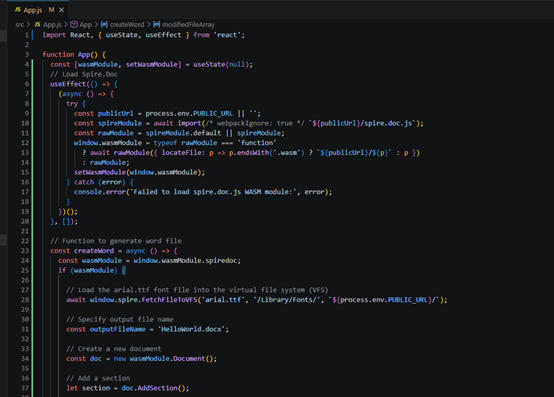
Here is the entire code:
- JavaScript
import React, { useState, useEffect } from 'react';

function App() {
  const [wasmModule, setWasmModule] = useState(null);
  // Load Spire.Doc
  useEffect(() => {
    (async () => {
      try {
        const publicUrl = process.env.PUBLIC_URL || '';
        const spireModule = await import(/* webpackIgnore: true */ `${publicUrl}/spire.doc.js`);
        const rawModule = spireModule.default || spireModule;
        window.wasmModule = typeof rawModule === 'function'
          ? await rawModule({ locateFile: p => p.endsWith('.wasm') ? `${publicUrl}/${p}` : p })
          : rawModule;
        setWasmModule(window.wasmModule);
      } catch (error) {
        console.error('Failed to load spire.doc.js WASM module:', error);
      }
    })();
  }, []);

  // Function to generate word file
  const createWord = async () => {
    const wasmModule = window.wasmModule.spiredoc;
    if (wasmModule) {

      // Load the arial.ttf font file into the virtual file system (VFS)
      await window.spire.FetchFileToVFS('arial.ttf', '/Library/Fonts/', `${process.env.PUBLIC_URL}/`);

      // Specify output file name
      const outputFileName = 'HelloWorld.docx';

      // Create a new document
      const doc = new wasmModule.Document();

      // Add a section
      let section = doc.AddSection();

      // Add a paragraph
      let paragraph = section.AddParagraph();

      // Append text to the paragraph
      paragraph.AppendText('Hello, World!');

      // Save the document to a Word file
      doc.SaveToFile({ fileName: outputFileName, fileFormat: wasmModule.FileFormat.Docx2013 });

      // Read the saved file and convert it to a Blob object
      const modifiedFileArray = window.dotnetRuntime.Module.FS.readFile(outputFileName);
      const modifiedFile = new Blob([modifiedFileArray], { type: 'application/vnd.openxmlformats-officedocument.wordprocessingml.document' });

      // Create a URL for the Blob and initiate the download
      const url = URL.createObjectURL(modifiedFile);
      const a = document.createElement('a');
      a.href = url;
      a.download = outputFileName;
      document.body.appendChild(a);
      a.click();
      document.body.removeChild(a);
      URL.revokeObjectURL(url);

      // Clean up resources
      doc.Dispose();
    }
  };

  return (
    <div style={{ textAlign: 'center', height: '300px' }}>
      <h1>Create a Word File Using JavaScript in React</h1>
      <button onClick={createWord} disabled={!wasmModule}>
        Generate
      </button>
    </div>
  );
}

export default App;
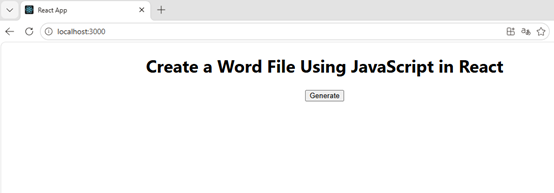
Start the development server by entering the following command in the terminal within VS Code: Once the React app is successfully compiled, it will open in your default web browser, typically at http://localhost:3000.Click "Generate" to create the 'HelloWorld.docx'. Click "Generate" and a "Save As" window will prompt you to save the output file in the designated folder. If you'd like to remove the evaluation message from the generated documents, or to get rid of the function limitations, please request a 30-day trial license for yourself.
npm start

Apply for a Temporary License
