Contracts and reports that go out to others usually carry a header and a footer beyond the body: the header says whose document this is, and the footer holds the page number and a note like "Internal use only". Typing them in by hand is slow and easy to miss, and handing the job to a server means the document has to leave the user's device first.
This article shows how to use Spire.PDF for JavaScript to add a text header and footer, an image header and footer, and automatic page numbers to an existing PDF. It loads, modifies and saves PDF documents directly in the browser with WebAssembly, draws the header and footer inside the blank areas the page already has, and reads and writes files through the virtual file system (VFS), with no backend involved.
This article covers three core features:
- Add a text header and footer
- Add an image to the header and footer
- Add automatic page numbers and total page count
For installation and project setup, see Integrate Spire.PDF for JavaScript into a React project. The examples below assume Spire.PDF is installed and the WebAssembly module is initialized.
Coordinate system
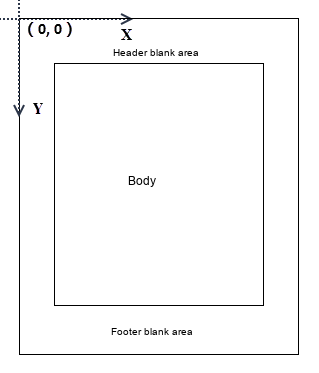
On an existing PDF page, the coordinate system is set up as follows: the origin is at the top-left corner of the page, the X axis extends to the right, and the Y axis extends downward (as shown below). Values are in points, and the drawing coordinates in the three features below all follow this convention.
Add a text header and footer
To give every page a fixed header and footer, draw the text at the target coordinates with DrawString on PdfPageBase.Canvas.
function App() {
  const addTextHeaderFooter = async () => {
    // Get the Spire.PDF WASM module
    const pdfModule = window.wasmModule?.spirepdf;

    // Check whether the module is ready
    if (!pdfModule) {
      alert('Spire.PDF is not ready yet');
      return;
    }

    // Load the font into the VFS for the header and footer text
    await window.spire.FetchFileToVFS('ARIAL.TTF', '/Library/Fonts/', `${process.env.PUBLIC_URL}/font/`);

    // Load the input PDF into the VFS
    const inputFileName = 'Multipage_Document.pdf';
    await window.spire.FetchFileToVFS(inputFileName, "", `${process.env.PUBLIC_URL}/data/`);

    // Create a PdfDocument object and load the PDF document
    const doc = new pdfModule.PdfDocument();
    doc.LoadFromFile(inputFileName);

    // Page margins, plus the pen, font and alignment shared by header and footer
    const margin = doc.PageSettings.Margins;
    const pen = new pdfModule.PdfPen({ brush: pdfModule.PdfBrushes.get_Black(), width: 0.75 });
    const font = new pdfModule.PdfTrueTypeFont({ fontFile: '/Library/Fonts/ARIAL.TTF', size: 10 });
    const brush = pdfModule.PdfBrushes.get_Black();
    const rightAlign = new pdfModule.PdfStringFormat({ alignment: pdfModule.PdfTextAlignment.Right });
    rightAlign.MeasureTrailingSpaces = true;

    // Gap between the separator line and the text
    const space = font.Height * 0.75;

    // Draw the header and footer page by page
    for (let i = 0; i < doc.Pages.Count; i++) {
      const canvas = doc.Pages.get_Item(i).Canvas;
      const x = margin.Left;
      const width = canvas.ClientSize.Width - margin.Left - margin.Right;

      // Header: draw the separator above the content area, right-align the title above the line
      let y = margin.Top - space;
      canvas.DrawLine({ pen: pen, x1: x, y1: y, x2: x + width, y2: y });
      canvas.DrawString({
        s: 'E-iceblue',
        font: font,
        brush: brush,
        x: x + width,
        y: y - font.Height,
        format: rightAlign
      });

      // Footer: draw the separator below the content area, right-align the note below the line
      y = canvas.ClientSize.Height - margin.Bottom + space;
      canvas.DrawLine({ pen: pen, x1: x, y1: y, x2: x + width, y2: y });
      canvas.DrawString({
        s: 'Internal use only',
        font: font,
        brush: brush,
        x: x + width,
        y: y + 1,
        format: rightAlign
      });
    }

    const outputFileName = 'Text_Header_Footer.pdf';
    doc.SaveToFile(outputFileName);
    doc.Close();

    // Read the generated file from the VFS and trigger the download
    const fileArray = window.dotnetRuntime.Module.FS.readFile(outputFileName);
    const blob = new Blob([fileArray], { type: 'application/pdf' });
    const url = URL.createObjectURL(blob);
    const a = document.createElement('a');
    a.href = url;
    a.download = outputFileName;
    a.click();
    URL.revokeObjectURL(url);
  };

  return (
    <div style={{ textAlign: 'center', height: '300px' }}>
      <h1>Add a Text Header and Footer</h1>
      <button onClick={addTextHeaderFooter}>
        Start Adding
      </button>
    </div>
  );
}

export default App;
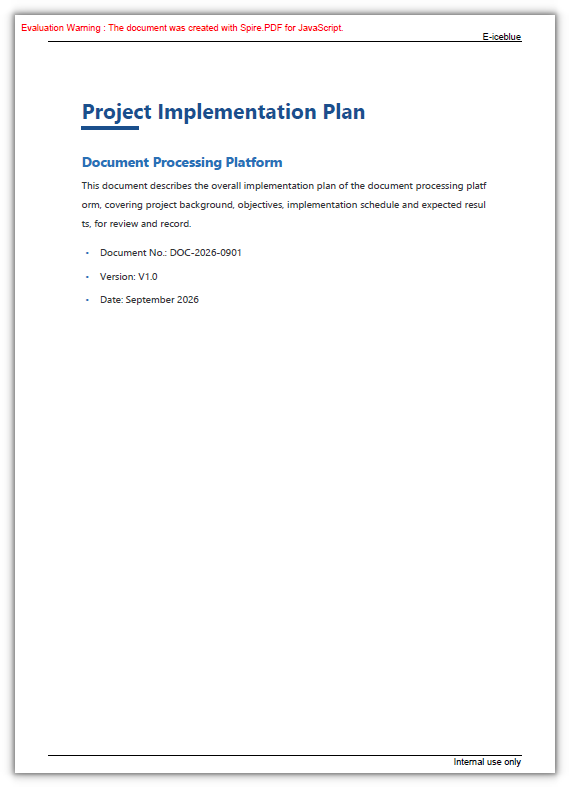
Every page carries a right-aligned header and footer, each separated from the body by a separator line:
Add an image to the header and footer
A company logo often goes into the header and footer too. PdfImage.FromFile reads the image from the virtual file system, and Canvas.DrawImage draws it by its top-left coordinates. The image size is in pixels, so convert it into points with PdfUnitConvertor first to line it up with the page coordinates.
function App() {
  const addImageHeaderFooter = async () => {
    // Get the Spire.PDF WASM module
    const pdfModule = window.wasmModule?.spirepdf;

    // Check whether the module is ready
    if (!pdfModule) {
      alert('Spire.PDF is not ready yet');
      return;
    }

    // Load the input PDF and the logo image into the VFS
    const inputFileName = 'Multipage_Document.pdf';
    const imageFileName = 'E-iceblue.png';
    await window.spire.FetchFileToVFS(inputFileName, "", `${process.env.PUBLIC_URL}/data/`);
    await window.spire.FetchFileToVFS(imageFileName, "", `${process.env.PUBLIC_URL}/data/`);

    // Create a PdfDocument object and load the PDF document
    const doc = new pdfModule.PdfDocument();
    doc.LoadFromFile(inputFileName);

    // Read the logo image and convert its pixel size into points
    const image = pdfModule.PdfImage.FromFile(imageFileName);
    const unitCvtr = new pdfModule.PdfUnitConvertor();
    const pointWidth = unitCvtr.ConvertUnits(image.Width, pdfModule.PdfGraphicsUnit.Pixel, pdfModule.PdfGraphicsUnit.Point);
    const pointHeight = unitCvtr.ConvertUnits(image.Height, pdfModule.PdfGraphicsUnit.Pixel, pdfModule.PdfGraphicsUnit.Point);

    // Draw the logo at the top-right of the header and the bottom-left of the footer, page by page
    for (let i = 0; i < doc.Pages.Count; i++) {
      const page = doc.Pages.get_Item(i);
      const canvas = page.Canvas;

      // Top-right of the header
      canvas.DrawImage({
        image: image,
        x: page.ActualSize.Width - pointWidth - 55,
        y: 20
      });

      // Bottom-left of the footer
      canvas.DrawImage({
        image: image,
        x: 55,
        y: page.ActualSize.Height - pointHeight - 20
      });
    }

    const outputFileName = 'Image_Header_Footer.pdf';
    doc.SaveToFile(outputFileName);
    doc.Close();

    // Read the generated file from the VFS and trigger the download
    const fileArray = window.dotnetRuntime.Module.FS.readFile(outputFileName);
    const blob = new Blob([fileArray], { type: 'application/pdf' });
    const url = URL.createObjectURL(blob);
    const a = document.createElement('a');
    a.href = url;
    a.download = outputFileName;
    a.click();
    URL.revokeObjectURL(url);
  };

  return (
    <div style={{ textAlign: 'center', height: '300px' }}>
      <h1>Add an Image to the Header and Footer</h1>
      <button onClick={addImageHeaderFooter}>
        Start Adding
      </button>
    </div>
  );
}

export default App;
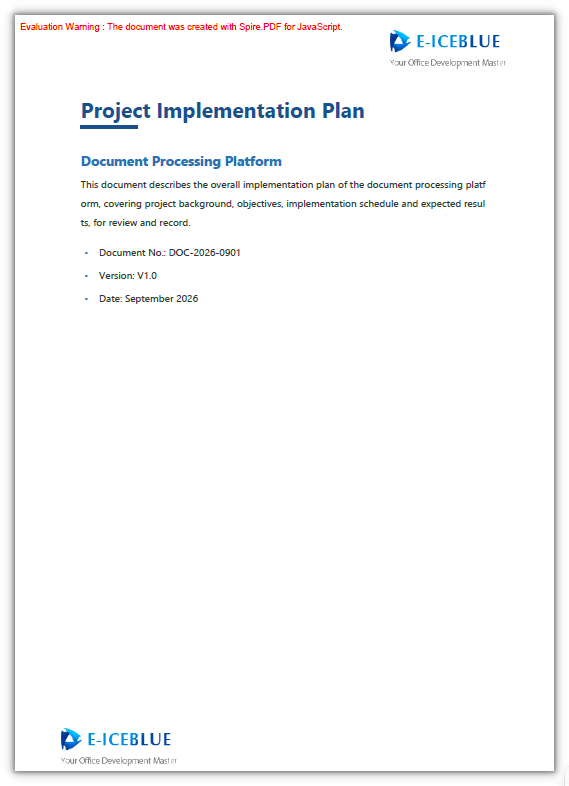
The company logo lands at the top-right of the header and the bottom-left of the footer:
Add automatic page numbers and total page count
The product provides the PdfPageNumberField and PdfPageCountField classes to get the current page number and the total number of pages in a PDF document. They can be merged into a PdfCompositeField that formats the output as "Page X of Y", where X is the current page number and Y is the total page count.
function App() {
  const addPageNumbers = async () => {
    // Get the Spire.PDF WASM module
    const pdfModule = window.wasmModule?.spirepdf;

    // Check whether the module is ready
    if (!pdfModule) {
      alert('Spire.PDF is not ready yet');
      return;
    }

    // Load the font into the VFS for the page number text
    await window.spire.FetchFileToVFS('ARIAL.TTF', '/Library/Fonts/', `${process.env.PUBLIC_URL}/font/`);

    // Load the input PDF into the VFS
    const inputFileName = 'Multipage_Document.pdf';
    await window.spire.FetchFileToVFS(inputFileName, "", `${process.env.PUBLIC_URL}/data/`);

    // Create a PdfDocument object and load the PDF document
    const doc = new pdfModule.PdfDocument();
    doc.LoadFromFile(inputFileName);

    // Page margins, plus the pen, font and alignment for the page number text
    const margin = doc.PageSettings.Margins;
    const pen = new pdfModule.PdfPen({ brush: pdfModule.PdfBrushes.get_Black(), width: 0.75 });
    const font = new pdfModule.PdfTrueTypeFont({ fontFile: '/Library/Fonts/ARIAL.TTF', size: 10 });
    const brush = pdfModule.PdfBrushes.get_Black();
    const rightAlign = new pdfModule.PdfStringFormat({ alignment: pdfModule.PdfTextAlignment.Right });
    rightAlign.MeasureTrailingSpaces = true;
    const space = font.Height * 0.75;

    // Two dynamic fields: the current page number and the total page count
    const number = new pdfModule.PdfPageNumberField();
    const count = new pdfModule.PdfPageCountField();

    // Join them into "Page X of Y" by placeholder order; the list order matches {0} and {1}
    const compositeField = new pdfModule.PdfCompositeField({
      font: font,
      brush: brush,
      text: 'Page {0} of {1}',
      list: [number, count]
    });
    compositeField.StringFormat = rightAlign;

    // Draw the separator line and place the right-aligned page number, page by page
    for (let i = 0; i < doc.Pages.Count; i++) {
      const canvas = doc.Pages.get_Item(i).Canvas;
      const x = margin.Left;
      const width = canvas.ClientSize.Width - margin.Left - margin.Right;

      // Draw a separator line below the content area
      const y = canvas.ClientSize.Height - margin.Bottom + space;
      canvas.DrawLine({ pen: pen, x1: x, y1: y, x2: x + width, y2: y });

      // Measure the text and place the page number below the line, flush with the right edge
      const size = font.MeasureString({ text: 'Page 1 of 1' });
      compositeField.Bounds = new pdfModule.RectangleF({
        x: x + width - size.Width,
        y: y + 1,
        width: size.Width,
        height: size.Height
      });

      // Draw the dynamic field directly onto the canvas
      compositeField.Draw({ graphics: canvas });
    }

    const outputFileName = 'Page_Number_Footer.pdf';
    doc.SaveToFile(outputFileName);
    doc.Close();

    // Read the generated file from the VFS and trigger the download
    const fileArray = window.dotnetRuntime.Module.FS.readFile(outputFileName);
    const blob = new Blob([fileArray], { type: 'application/pdf' });
    const url = URL.createObjectURL(blob);
    const a = document.createElement('a');
    a.href = url;
    a.download = outputFileName;
    a.click();
    URL.revokeObjectURL(url);
  };

  return (
    <div style={{ textAlign: 'center', height: '300px' }}>
      <h1>Add Page Numbers</h1>
      <button onClick={addPageNumbers}>
        Start Adding
      </button>
    </div>
  );
}

export default App;
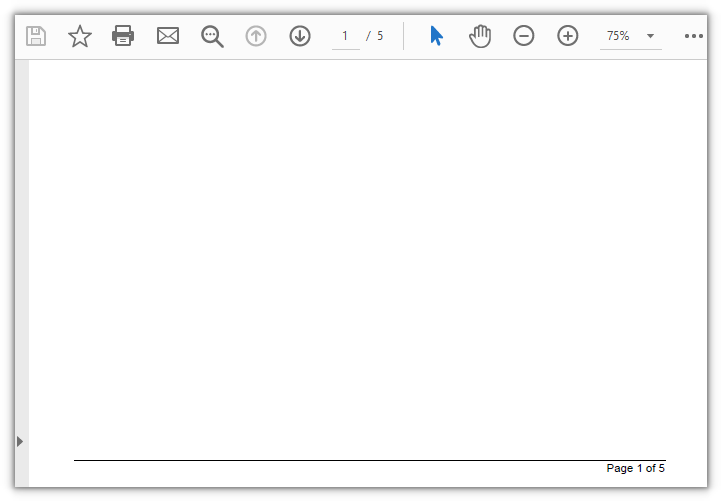
The footer shows "Page X of Y" right-aligned below the separator line:
Frequently Asked Questions
The header and footer are drawn on top of the body text
Cause: The header and footer are layered onto the page, and their position comes from the coordinates derived from PageSettings.Margins. If the loaded PDF has very little blank space at the top and bottom, that text overlaps the body.
Solution: Save the original page as a template first, and after drawing the header and footer, draw the original content back into place so the body and the header/footer each take their own layer. If you don't need layers, use a source file with enough blank space at the top and bottom:
// Save the current page content as a template
const template = page.CreateTemplate();

// After drawing the header and footer, lay the original content back over the full page
const graphicsWidget = new pdfModule.PdfGraphicsWidget(template.H);
graphicsWidget.Draw({ graphics: canvas, location: new pdfModule.PointF(0, 0) });
The header and footer text shows up as boxes
Cause: The font has no glyphs for those characters. Rendering CJK text with a Latin font such as ARIAL.TTF finds no matching glyph, so the page shows empty boxes.
Solution: Switch to a font file that includes those glyphs, and load it into /Library/Fonts/ in the virtual file system first:
// Load a CJK-capable font first, then hand it to PdfTrueTypeFont
await window.spire.FetchFileToVFS('SIMSUN.TTF', '/Library/Fonts/', `${process.env.PUBLIC_URL}/font/`);
const font = new pdfModule.PdfTrueTypeFont({ fontFile: '/Library/Fonts/SIMSUN.TTF', size: 10 });
The page number numbers don't match
Cause: The text of PdfCompositeField uses {0} and {1} as placeholders, filled in the order given by list. Putting PdfPageCountField before PdfPageNumberField, or swapping the two placeholders in text, makes the page number and the total page count trade places.
Solution: Keep the placeholder order consistent with list: page number first, total page count second:
const compositeField = new pdfModule.PdfCompositeField({
  font: font,
  brush: brush,
  text: 'Page {0} of {1}',
  list: [number, count]
});
Get a Free License
If you want to remove the evaluation message from the resulting document, or get past the feature limits, contact sales for a temporary 30-day license.
