
Knowledgebase (2417)
Children categories
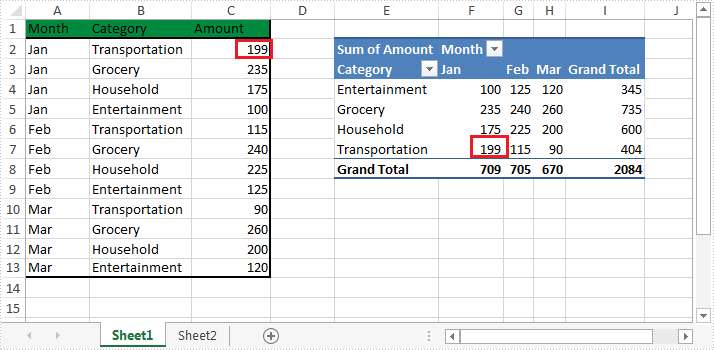
By default, the data source of PivotTable won't be refreshed automatically. If we update the data source of our PivotTable, the PivotTable that was built on that data source needs to be refreshed. This article is going to elaborate how to refresh PivotTable in Excel programmatically in c# using Spire.XLS.
Below is the screenshot of the example Excel file:

Detail steps:
Step 1: Instantiate a Workbook object and load the Excel file.
Workbook workbook = new Workbook();
workbook.LoadFromFile(@"Sample.xlsx");
Step 2: Get the first worksheet.
Worksheet sheet = workbook.Worksheets[0];
Step 3: update the data source of PivotTable.
sheet.Range["C2"].Value = "199";
Step 4: Get the PivotTable that was built on the data source.
XlsPivotTable pt = workbook.Worksheets[0].PivotTables[0] as XlsPivotTable;
Step 5: Refresh the data of PivotTable.
pt.Cache.IsRefreshOnLoad = true;
Step 6: Save the file.
workbook.SaveToFile("Output.xlsx", ExcelVersion.Version2013);
Output after updating data source and refreshing the PivotTable:
Full code:
using Spire.Xls;
using Spire.Xls.Core.Spreadsheet.PivotTables;

namespace Refresh_Pivot_Table_in_Excel
{
    class Program
    {
        static void Main(string[] args)
        {
            //Instantiate a Workbook object
            Workbook workbook = new Workbook();
            //Load the Excel file
            workbook.LoadFromFile(@"Sample.xlsx");

            //Get the first worksheet
            Worksheet sheet = workbook.Worksheets[0];

            //Update the data source of PivotTable
            sheet.Range["C2"].Value = "199";

            //Get the PivotTable that was built on the data source
            XlsPivotTable pt = workbook.Worksheets[0].PivotTables[0] as XlsPivotTable;

            //Refresh the data of PivotTable
            pt.Cache.IsRefreshOnLoad = true;

            //Save the file
            workbook.SaveToFile("Output.xlsx", ExcelVersion.Version2013);
        }
    }
}
A header can provide useful information about the document's content, such as its title, author, date, and page numbers. This helps readers understand the document's purpose and navigate it more easily. In addition, including a logo or company name in the header reinforces brand identity and helps readers associate the document with a particular organization or business. In this article, you will learn how to add a header to an existing PDF document in C# and VB.NET using Spire.PDF for .NET.
Install Spire.PDF for .NET
To begin with, you need to add the DLL files included in the Spire.PDF for.NET package as references in your .NET project. The DLL files can be either downloaded from this link or installed via NuGet.
PM> Install-Package Spire.PDF
Background Knowledge
When an existing PDF document is manipulated by Spire.PDF for .NET, the origin of the coordinate system is located at the top left corner of the page, with the x-axis extending to the right and the y-axis extending downward. Adding a header to a page means adding content, such as text, images, automatic fields and shapes, to a specified location in the upper blank area of the page.

If the blank area is not large enough to accommodate the content you want to add, you can consider increasing the PDF page margins.
Add a Header to an Existing PDF Document in C# and VB.NET
Spire.PDF for .NET allows users to draw text, images and shapes on a PDF page using PdfCanvas.DrawString() method, PdfCanvas.DrawImage() method, PdfCanvas.DrawLine() and other similar methods. To add dynamic information to the header, such as page numbers, sections, dates, you need to resort to automatic fields. Spire.PDF for .NET provides the PdfPageNumberField class, PdfSectionNumberField class, PdfCreationDateField class, etc. to achieve the dynamic addition of these data.
The following are the steps to add a header consisting of text, an image, a date, and a line to a PDF document using Spire.PDF for .NET.
- Create a PdfDocument object.
- Load a PDF document using PdfDocument.LoadFromFile() method.
- Create font, pen and brush objects that will be used to draw text or shapes.
- Draw text on the top blank area of a page using PdfPageBase.Canvas.DrawString() method.
- Draw a line on the top blank area of a page using PdfPageBase.Canvas.DrawLine() method.
- Load an image using PdfImage.FromFile() method.
- Draw the image on the top blank area of a page using PdfPageBase.Canvas.DrawImage() method.
- Create a PdfCreationDateField object that reflects the creation time of the document.
- Draw the creation time on the top blank area of a page using PdfCreationDateField.Draw() method.
- Save the document to another PDF file using PdfDocument.SaveToFile() method.
- C#
- VB.NET
using Spire.Pdf;
using Spire.Pdf.AutomaticFields;
using Spire.Pdf.Graphics;
using System.Drawing;

namespace AddHeaderToExistingPdf
{
    class Program
    {
        static void Main(string[] args)
        {
            //Create a PdfDocument object
            PdfDocument doc = new PdfDocument();

            //Load a PDF file
            doc.LoadFromFile("C:\\Users\\Administrator\\Desktop\\TargetMarket.pdf");

            //Load an image for the header
            PdfImage headerImage = PdfImage.FromFile("C:\\Users\\Administrator\\Desktop\\logo.png");

            //Get image width in pixel
            float width = headerImage.Width;

            //Convert pixel to point
            PdfUnitConvertor unitCvtr = new PdfUnitConvertor();
            float pointWidth = unitCvtr.ConvertUnits(width, PdfGraphicsUnit.Pixel, PdfGraphicsUnit.Point);

            //Specify text for the header
            string headerText = "E-iceblue Tech\nwww.e-iceblue.com";

            //Create a true type font
            PdfTrueTypeFont font = new PdfTrueTypeFont(new Font("Times New Roman", 12f, FontStyle.Bold), true);

            //Create a brush
            PdfBrush brush = PdfBrushes.Purple;

            //Create a pen
            PdfPen pen = new PdfPen(brush, 1.0f);

            //Create a creation date field
            PdfCreationDateField creationDateField = new PdfCreationDateField(font, brush);
            creationDateField.DateFormatString = "yyyy-MM-dd";

            //Create a composite field to combine static string and date field
            PdfCompositeField compositeField = new PdfCompositeField(font, brush, "creation time: {0}", creationDateField);
            compositeField.Location = new Point(55, 48);

            //Loop through the pages in the document
            for (int i = 0; i < doc.Pages.Count; i++)
            {
                //Get specific page
                PdfPageBase page = doc.Pages[i];

                //Draw the image on the top blank area
                page.Canvas.DrawImage(headerImage, page.ActualSize.Width - pointWidth - 55, 20);

                //Draw text on the top blank area
                page.Canvas.DrawString(headerText, font, brush, 55, 20);

                //Draw a line on the top blank area
                page.Canvas.DrawLine(pen, new PointF(55, 70), new PointF(page.ActualSize.Width - 55, 70));

                //Draw the composite field on the top blank area
                compositeField.Draw(page.Canvas);
            }

            //Save to file
            doc.SaveToFile("AddHeader.pdf");
            doc.Dispose();
        }
    }
}

Apply for a Temporary License
If you'd like to remove the evaluation message from the generated documents, or to get rid of the function limitations, please request a 30-day trial license for yourself.
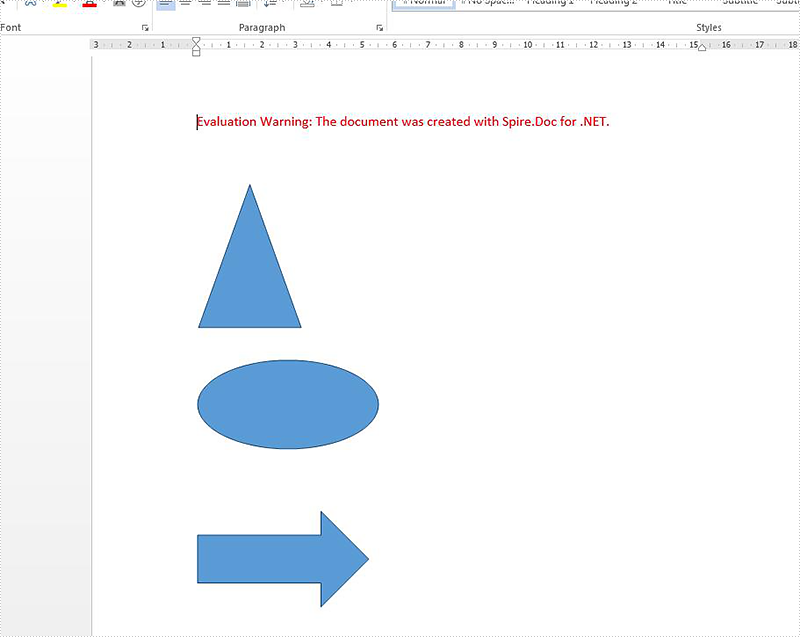
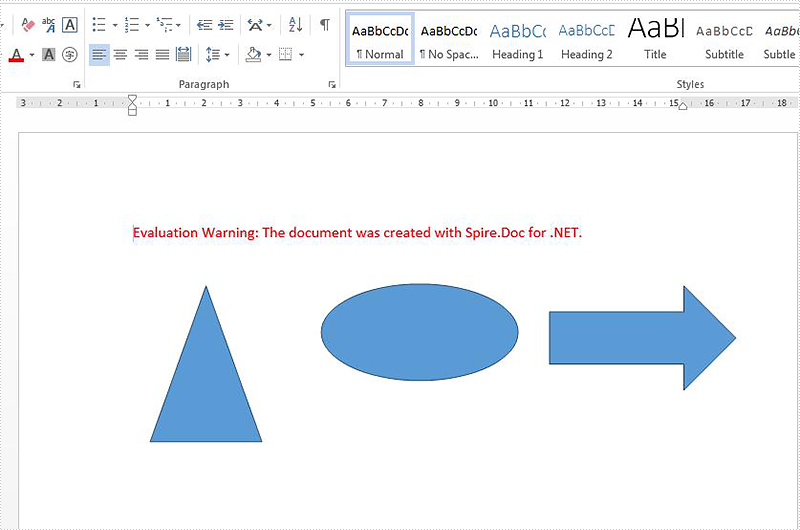
Spire.Doc offers the property ShapeObject. HorizontalAlignment and ShapeObject. Vertical Alignment to enable developers to align the shapes horizontally or vertically. This article will show you to how to align the shapes on the word document in C#.
Step 1: Create a new instance of word document and load the document from file.
Document doc = new Document();
doc.LoadFromFile("Sample.docx");
Step 2: Get the first section from file.
Section section = doc.Sections[0];
Step 3: Traverse the word document and set the horizontal alignment as left.
foreach (Paragraph para in section.Paragraphs)
{
    foreach (DocumentObject obj in para.ChildObjects)
    {
        if (obj is ShapeObject)
        {
          (obj as ShapeObject).HorizontalAlignment = ShapeHorizontalAlignment.Left;

        }
    }
}
Step 4: Save the document to file.
doc.SaveToFile("Result.docx", FileFormat.Docx);
Effective screenshot after setting the alignment of the shapes.
Full codes:
using Spire.Doc;
using Spire.Doc.Documents;
using Spire.Doc.Fields;
namespace AlignShape
{
    class Program
    {
        static void Main(string[] args)
        {
            Document doc = new Document();
            doc.LoadFromFile("Sample.docx");

            Section section = doc.Sections[0];

            foreach (Paragraph para in section.Paragraphs)
            {
                foreach (DocumentObject obj in para.ChildObjects)
                {
                    if (obj is ShapeObject)
                    {
                        (obj as ShapeObject).HorizontalAlignment = ShapeHorizontalAlignment.Left;

                        ////Set the vertical alignment as top
                        //(obj as ShapeObject).VerticalAlignment = ShapeVerticalAlignment.Top;
                    }
                }
            }

            doc.SaveToFile("Result.docx", FileFormat.Docx2013);
        }
    }
}
