Knowledgebase (2417)
Children categories
Using Spire.Doc for WPF, programmers can easily create, open, modify and save Word documents in WPF applications. In this article, we’ll introduce how to insert a paragraph to desired position in an existing Word document.
To begin with, you need to download Spire.Doc for WPF and add the Spire.Doc.Wpf.dll and Spire.License.dll as the references to your WPF project. Then add a button in MainWindow and double click the button to write code.
Here are code snippets in the button click event:
Step 1: Initialize a new instance of Document class and load the sample Word document.
Document document = new Document();
document.LoadFromFile("sample.docx", FileFormat.Docx);
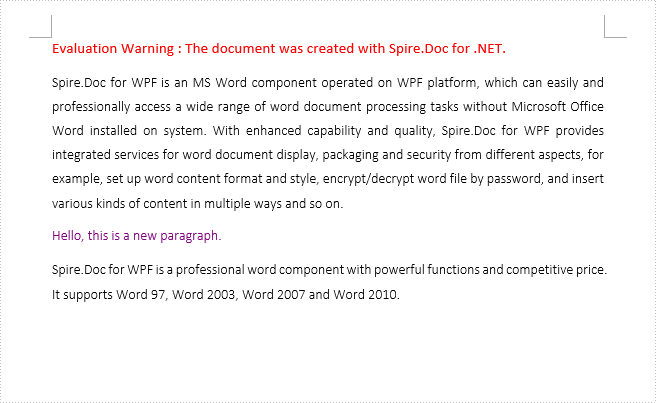
Step 2: Initialize a new instance of Paragraph class and append some text to it.
Paragraph paraInserted = new Paragraph(document);
TextRange textRange1 = paraInserted.AppendText("Hello, this is a new paragraph.");
Step 3: Set the text formatting of the paragraph.
textRange1.CharacterFormat.TextColor = System.Drawing.Color.Purple;
textRange1.CharacterFormat.FontSize = 11;
textRange1.CharacterFormat.FontName = "Calibri Light";
Step 4: Insert the paragraph at the first section at index 1, which indicates the position of the second paragraph in the section.
document.Sections[0].Paragraphs.Insert(1, paraInserted);
Step 5: Save the file.
document.SaveToFile("result.docx", FileFormat.Docx);
Output:
Full Code:
using Spire.Doc;
using Spire.Doc.Documents;
using Spire.Doc.Fields;
using System.Windows;

namespace WpfApplication1
{
    public partial class MainWindow : Window
    {
        public MainWindow()
        {
            InitializeComponent();
        }
        private void button1_Click(object sender, RoutedEventArgs e)
        {
            Document document = new Document();
            document.LoadFromFile("sample.docx", FileFormat.Docx);

            Paragraph paraInserted = new Paragraph(document);
            TextRange textRange1 = paraInserted.AppendText("Hello, this is a new paragraph.");
            textRange1.CharacterFormat.TextColor = System.Drawing.Color.Purple;
            textRange1.CharacterFormat.FontSize = 11;
            textRange1.CharacterFormat.FontName = "Calibri Light";

            document.Sections[0].Paragraphs.Insert(1, paraInserted);
            document.SaveToFile("result.docx", FileFormat.Docx);
        }


    }
}
Imports Spire.Doc
Imports Spire.Doc.Documents
Imports Spire.Doc.Fields
Imports System.Windows

Namespace WpfApplication1
	Public Partial Class MainWindow
		Inherits Window
		Public Sub New()
			InitializeComponent()
		End Sub
		Private Sub button1_Click(sender As Object, e As RoutedEventArgs)
			Dim document As New Document()
			document.LoadFromFile("sample.docx", FileFormat.Docx)

			Dim paraInserted As New Paragraph(document)
			Dim textRange1 As TextRange = paraInserted.AppendText("Hello, this is a new paragraph.")
			textRange1.CharacterFormat.TextColor = System.Drawing.Color.Purple
			textRange1.CharacterFormat.FontSize = 11
			textRange1.CharacterFormat.FontName = "Calibri Light"

			document.Sections(0).Paragraphs.Insert(1, paraInserted)
			document.SaveToFile("result.docx", FileFormat.Docx)
		End Sub


	End Class
End Namespace
This article is going to introduce how to create, write and save word document in WPF via Spire.Doc for WPF.
Spire.Doc for WPF enables users to do a large range of manipulations (such as create, write, open, edit, convert and save, etc.) on word with high performance and efficiency. In addition, as a powerful and independent library, it doesn’t require Microsoft Office or any other 3rd party tools to be installed on system.
Note: please download and install Spire.Doc correctly and add the dll file from the installation folder as reference.
First, let’s begin to create a word document in WPF.
Use namespace:
using System.Windows;
using Spire.Doc;
using Spire.Doc.Documents;
Step 1: Create a new word document instance, next add a section and a paragraph to it.
//Create New Word
Document doc = new Document();
//Add Section
Section section = doc.AddSection();
//Add Paragraph
Paragraph Para = section.AddParagraph();
Second, we’re going to write something into the document.
Step 2: Append some text to it.
//Append Text
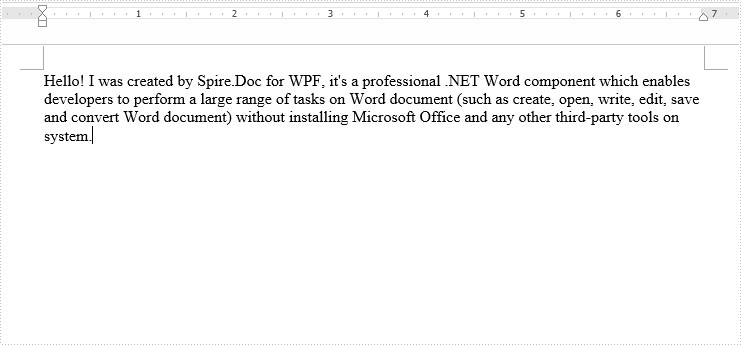
Para.AppendText("Hello! "
+ "I was created by Spire.Doc for WPF, it's a professional .NET Word component "
+ "which enables developers to perform a large range of tasks on Word document (such as create, open, write, edit, save and convert "
+ "Word document) without installing Microsoft Office and any other third-party tools on system.");
Third, save the generated document.
Step 3: Save and launch the document.
//Save and launch
doc.SaveToFile("MyWord.docx", FileFormat.Docx);
System.Diagnostics.Process.Start("MyWord.docx");
Output:
Full codes:
using Spire.Doc;
using Spire.Doc.Documents;
using System.Windows;

namespace WpfApplication1
{
    public partial class MainWindow : Window
    {
        public MainWindow()
        {
            InitializeComponent();
        }
        private void button1_Click(object sender, RoutedEventArgs e)
        {
            //Create New Word
            Document doc = new Document();
            //Add Section
            Section section = doc.AddSection();
            //Add Paragraph
            Paragraph Para = section.AddParagraph();
            //Append Text
            Para.AppendText("Hello! "
            + "I was created by Spire.Doc for WPF, it's a professional .NET Word component "
            + "which enables developers to perform a large range of tasks on Word document (such as create, open, write, edit, save and convert "
            + "Word document) without installing Microsoft Office and any other third-party tools on system.");
            //Save and launch
            doc.SaveToFile("MyWord.docx", Spire.Doc.FileFormat.Docx);
            System.Diagnostics.Process.Start("MyWord.docx");
        }

    }
}
Embed uninstalled fonts by font document when convert word to PDF
2016-01-21 08:27:32 Written by KoohjiWe have already shown you how to use uninstalled font by font document when converting word to PDF. Now starts from Spire.Doc 5.6.3, Spire.Doc newly supports to set the font styles for the uninstalled fonts when convert word documents to PDF. Here comes to the code snippets of how to set the font styles for embed the uninstalled fonts by font documents:
Note: Before Start, please download the latest version of Spire.XLS and add Spire.xls.dll in the bin folder as the reference of Visual Studio.
Step 1: Create a new workbook and load from file.
Document document = new Document();
document.LoadFromFile("Testing.docx");
Step 2: Create an instance for class ToPdfParameterList named parms.
ToPdfParameterList parms = new ToPdfParameterList();
Step 3: Define the path of the uninstalled fonts.
   {
      new PrivateFontPath("Century Gothic",FontStyle.Regular,"fonts\\GOTHIC.TTF"),
      new PrivateFontPath("Century Gothic",FontStyle.Bold,"fonts\\GOTHICB.TTF"),
      new PrivateFontPath("Century Gothic",FontStyle.Italic,"fonts\\GOTHICI.TTF") ,
      new PrivateFontPath("Century Gothic",FontStyle.Bold|FontStyle.Italic,"fonts\\GOTHICBI.TTF")

   };
Step 4: Save the document to file and launch to preview it.
document.SaveToFile("Testing.pdf", parms);
System.Diagnostics.Process.Start("Testing.pdf");
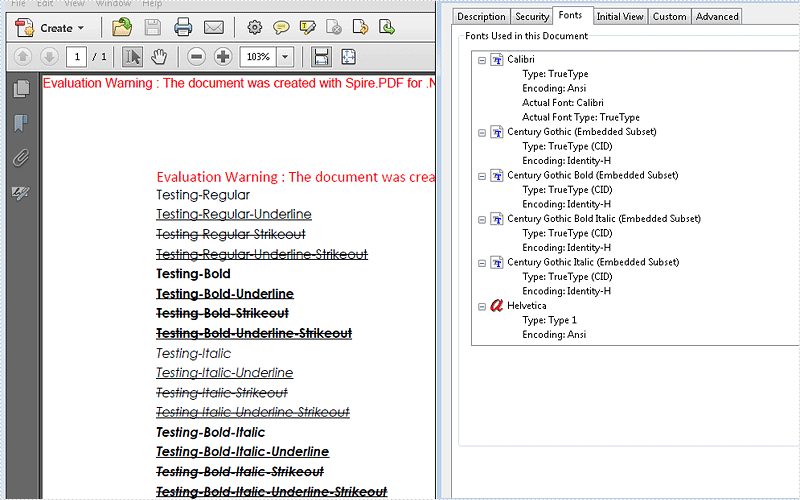
Effective screenshot of the embedded uninstalled fonts by setting the font style after converts to PDF: