Knowledgebase (2417)
Children categories
Adding, inserting, and deleting pages in a Word document are crucial steps in managing and presenting content. By adding or inserting new pages, you can expand the document to accommodate more content, making it more organized and readable. Deleting pages helps simplify the document by removing unnecessary or erroneous information. These operations can enhance the overall quality and clarity of the document. This article will demonstrate how to use Spire.Doc for Java to add, insert, and delete pages in a Word document within a Java project.
- Add a Page in a Word Document in Java
- Insert a Page in a Word Document in Java
- Delete a Page from a Word Document in Java
Install Spire.Doc for Java
First, you're required to add the Spire.Doc.jar file as a dependency in your Java program. The JAR file can be downloaded from this link. If you use Maven, you can easily import the JAR file in your application by adding the following code to your project's pom.xml file.
<repositories>
    <repository>
        <id>com.e-iceblue</id>
        <name>e-iceblue</name>
        <url>https://repo.e-iceblue.com/nexus/content/groups/public/</url>
    </repository>
</repositories>
<dependencies>
    <dependency>
        <groupId>e-iceblue</groupId>
        <artifactId>spire.doc</artifactId>
        <version>14.8.4</version>
    </dependency>
</dependencies>
Add a Page in a Word Document in Java
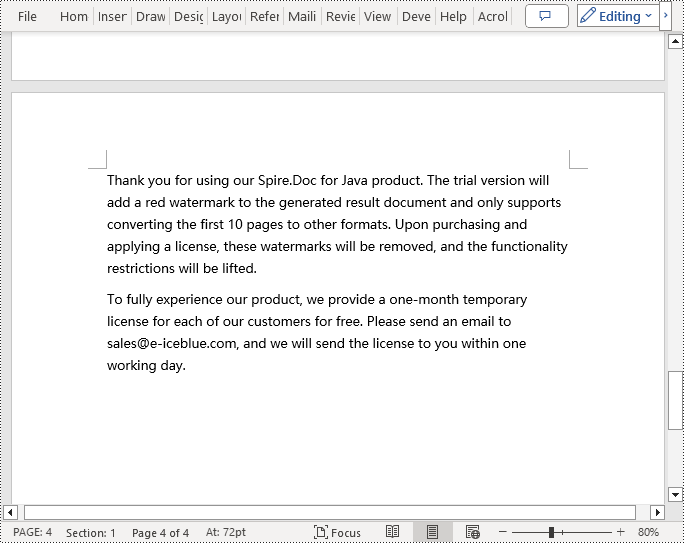
The steps to add a new page at the end of a Word document include locating the last section, and then inserting a page break at the end of that section's last paragraph. This way ensures that any content added subsequently will start displaying on a new page, maintaining the clarity and coherence of the document structure. The detailed steps are as follows:
- Create a Document object.
- Load a Word document using the Document.loadFromFile() method.
- Get the body of the last section of the document using Document.getLastSection().getBody().
- Add a page break by calling Paragraph.appendBreak(BreakType.Page_Break) method.
- Create a new paragraph style ParagraphStyle object.
- Add the new paragraph style to the document's style collection using Document.getStyles().add(paragraphStyle) method.
- Create a new paragraph Paragraph object and set the text content.
- Apply the previously created paragraph style to the new paragraph using Paragraph.applyStyle(paragraphStyle.getName()) method.
- Add the new paragraph to the document using Body.getChildObjects().add(paragraph) method.
- Save the resulting document using the Document.saveToFile() method.
- Java
import com.spire.doc.*;
import com.spire.doc.documents.*;

public class AddOnePage {
    public static void main(String[] args) {
        // Create a new document object
        Document document = new Document();

        // Load a sample document from a file
        document.loadFromFile("Sample.docx");

        // Get the body of the last section of the document
        Body body = document.getLastSection().getBody();

        // Insert a page break after the last paragraph in the body
        body.getLastParagraph().appendBreak(BreakType.Page_Break);

        // Create a new paragraph style
        ParagraphStyle paragraphStyle = new ParagraphStyle(document);
        paragraphStyle.setName("CustomParagraphStyle1");
        paragraphStyle.getParagraphFormat().setLineSpacing(12);
        paragraphStyle.getParagraphFormat().setAfterSpacing(8);
        paragraphStyle.getCharacterFormat().setFontName("Microsoft YaHei");
        paragraphStyle.getCharacterFormat().setFontSize(12);

        // Add the paragraph style to the document's style collection
        document.getStyles().add(paragraphStyle);

        // Create a new paragraph and set the text content
        Paragraph paragraph = new Paragraph(document);
        paragraph.appendText("Thank you for using our Spire.Doc for Java product. The trial version will add a red watermark to the generated result document and only supports converting the first 10 pages to other formats. Upon purchasing and applying a license, these watermarks will be removed, and the functionality restrictions will be lifted.");

        // Apply the paragraph style
        paragraph.applyStyle(paragraphStyle.getName());

        // Add the paragraph to the body's content collection
        body.getChildObjects().add(paragraph);

        // Create another new paragraph and set the text content
        paragraph = new Paragraph(document);
        paragraph.appendText("To fully experience our product, we provide a one-month temporary license for each of our customers for free. Please send an email to sales@e-iceblue.com, and we will send the license to you within one working day.");

        // Apply the paragraph style
        paragraph.applyStyle(paragraphStyle.getName());

        // Add the paragraph to the body's content collection
        body.getChildObjects().add(paragraph);

        // Save the document to a specified path
        document.saveToFile("Add a Page.docx", FileFormat.Docx);

        // Close the document
        document.close();

        // Dispose of the document object's resources
        document.dispose();
    }
}
Insert a Page in a Word Document in Java
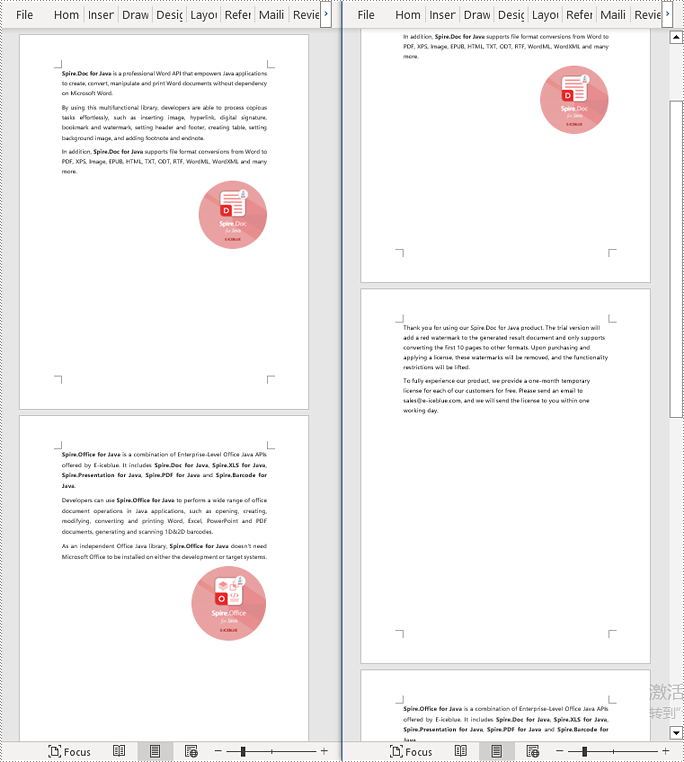
Before inserting a new page, it is necessary to determine the ending position index of the specified page content within the section, and then add the content of the new page to the document one by one. To ensure that the content is separated from the subsequent pages, page breaks need to be inserted at appropriate positions. The detailed steps are as follows:
- Create a Document object.
- Load a Word document using the Document.loadFromFile() method.
- Create a FixedLayoutDocument object.
- Obtain the FixedLayoutPage object of a page in the document.
- Get the index position of the last paragraph on the page within the section.
- Create a new paragraph style ParagraphStyle object.
- Add the new paragraph style to the document using the Document.getStyles().add(paragraphStyle) method.
- Create a new paragraph Paragraph object and set the text content.
- Apply the previously created paragraph style to the new paragraph using the Paragraph.applyStyle(paragraphStyle.getName()) method.
- Insert the new paragraph at the specified position using the Body.getChildObjects().insert(index, Paragraph) method.
- Create another new paragraph object, set its text content, add a page break by calling the Paragraph.appendBreak(BreakType.Page_Break) method, apply the previously created paragraph style, and finally insert this paragraph into the document.
- Save the resulting document using the Document.saveToFile() method.
- Java
import com.spire.doc.*;
import com.spire.doc.pages.*;
import com.spire.doc.documents.*;

public class InsertOnePage {
    public static void main(String[] args) {
        // Create a new document object
        Document document = new Document();

        // Load a sample document from a file
        document.loadFromFile("Sample.docx");

        // Create a fixed layout document object
        FixedLayoutDocument layoutDoc = new FixedLayoutDocument(document);

        // Get the first page
        FixedLayoutPage page = layoutDoc.getPages().get(0);

        // Get the body of the document
        Body body = page.getSection().getBody();

        // Get the paragraph at the end of the current page
        Paragraph paragraphEnd = page.getColumns().get(0).getLines().getLast().getParagraph();

        // Initialize the end index
        int endIndex = 0;
        if (paragraphEnd != null) {
            // Get the index of the last paragraph
            endIndex = body.getChildObjects().indexOf(paragraphEnd);
        }

        // Create a new paragraph style
        ParagraphStyle paragraphStyle = new ParagraphStyle(document);
        paragraphStyle.setName("CustomParagraphStyle1");
        paragraphStyle.getParagraphFormat().setLineSpacing(12);
        paragraphStyle.getParagraphFormat().setAfterSpacing(8);
        paragraphStyle.getCharacterFormat().setFontName("Microsoft YaHei");
        paragraphStyle.getCharacterFormat().setFontSize(12);

        // Add the style to the document
        document.getStyles().add(paragraphStyle);

        // Create a new paragraph and set the text content
        Paragraph paragraph = new Paragraph(document);
        paragraph.appendText("Thank you for using our Spire.Doc for Java product. The trial version will add a red watermark to the generated result document and only supports converting the first 10 pages to other formats. Upon purchasing and applying a license, these watermarks will be removed, and the functionality restrictions will be lifted.");

        // Apply the paragraph style
        paragraph.applyStyle(paragraphStyle.getName());

        // Insert the paragraph at the specified position
        body.getChildObjects().insert(endIndex + 1, paragraph);

        // Create another new paragraph and set the text content
        paragraph = new Paragraph(document);
        paragraph.appendText("To fully experience our product, we provide a one-month temporary license for each of our customers for free. Please send an email to sales@e-iceblue.com, and we will send the license to you within one working day.");

        // Apply the paragraph style
        paragraph.applyStyle(paragraphStyle.getName());

        // Add a page break
        paragraph.appendBreak(BreakType.Page_Break);

        // Insert the paragraph at the specified position
        body.getChildObjects().insert(endIndex + 2, paragraph);

        // Save the document to a specified path
        document.saveToFile("Insert a New Page after a Specified Page.docx", FileFormat.Docx);

        // Close and dispose of the document object's resources
        document.close();
        document.dispose();
    }
}
Delete a Page from a Word Document in Java
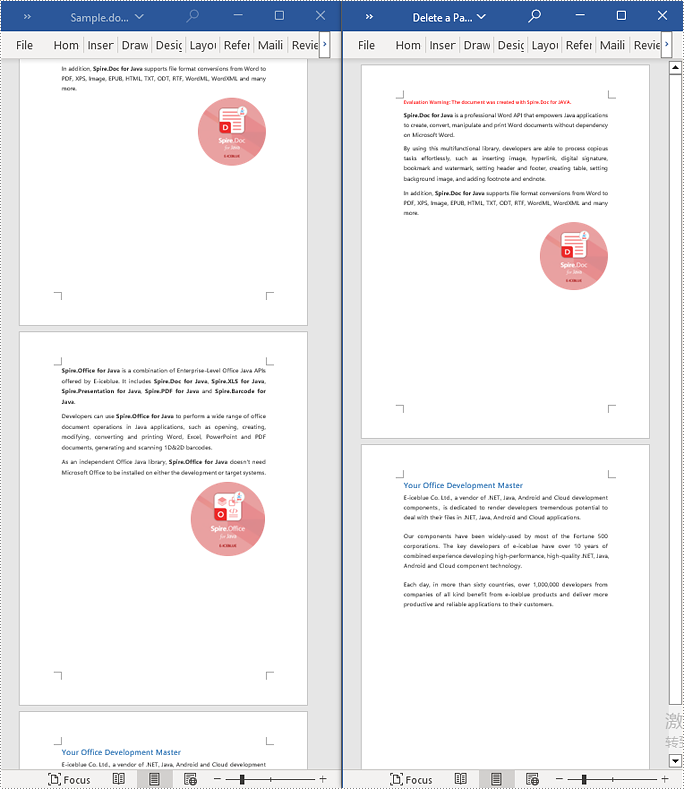
To delete the content of a page, you first need to find the position index of the starting and ending elements of that page in the document. Then, by looping through, you can remove these elements one by one to delete the entire content of the page. The detailed steps are as follows:
- Create a Document object.
- Load a Word document using the Document.loadFromFile() method.
- Create a FixedLayoutDocument object.
- Obtain the FixedLayoutPage object of the first page in the document.
- Use the FixedLayoutPage.getSection() method to get the section where the page is located.
- Get the index position of the first paragraph on the page within the section.
- Get the index position of the last paragraph on the page within the section.
- Use a for loop to remove the content of the page one by one.
- Save the resulting document using the Document.saveToFile() method.
- Java
import com.spire.doc.*;
import com.spire.doc.pages.*;
import com.spire.doc.documents.*;

public class RemoveOnePage {
    public static void main(String[] args) {
        // Create a new document object
        Document document = new Document();

        // Load a sample document from a file
        document.loadFromFile("Sample.docx");

        // Create a fixed layout document object
        FixedLayoutDocument layoutDoc = new FixedLayoutDocument(document);

        // Get the second page
        FixedLayoutPage page = layoutDoc.getPages().get(1);

        // Get the section of the page
        Section section = page.getSection();

        // Get the first paragraph on the first page
        Paragraph paragraphStart = page.getColumns().get(0).getLines().getFirst().getParagraph();
        int startIndex = 0;
        if (paragraphStart != null) {
            // Get the index of the starting paragraph
            startIndex = section.getBody().getChildObjects().indexOf(paragraphStart);
        }

        // Get the last paragraph on the last page
        Paragraph paragraphEnd = page.getColumns().get(0).getLines().getLast().getParagraph();

        int endIndex = 0;
        if (paragraphEnd != null) {
            // Get the index of the ending paragraph
            endIndex = section.getBody().getChildObjects().indexOf(paragraphEnd);
        }

        // Remove paragraphs within the specified range
        for (int i = 0; i <= (endIndex - startIndex); i++) {
            section.getBody().getChildObjects().removeAt(startIndex);
        }

        // Save the document to a specified path
        document.saveToFile("Delete a Page.docx", FileFormat.Docx);

        // Close and dispose of the document object's resources
        document.close();
        document.dispose();
    }
}
Apply for a Temporary License
If you'd like to remove the evaluation message from the generated documents, or to get rid of the function limitations, please request a 30-day trial license for yourself.
Converting Word documents to XPS, PostScript, and OFD documents is of significant importance. Firstly, this conversion makes it easier to share and display documents across different platforms and applications, as these formats typically have broader compatibility.
Secondly, converting to these formats can preserve the document's formatting, layout, and content, ensuring consistent display across different systems.
Additionally, XPS and OFD formats support high-quality printing, helping to maintain the visual appearance and print quality of the document. The PostScript format is commonly used for printing and graphic processing, converting to PostScript can ensure that the document maintains high quality when printed.
In this article, you will learn how to convert Word to XPS, PostScript, or OFD with Python using Spire.Doc for Python.
Install Spire.Doc for Python
This scenario requires Spire.Doc for Python and plum-dispatch v1.7.4. They can be easily installed in your Windows through the following pip commands.
pip install Spire.Doc
If you are unsure how to install, please refer to this tutorial: How to Install Spire.Doc for Python on Windows
Convert Word to XPS in Python
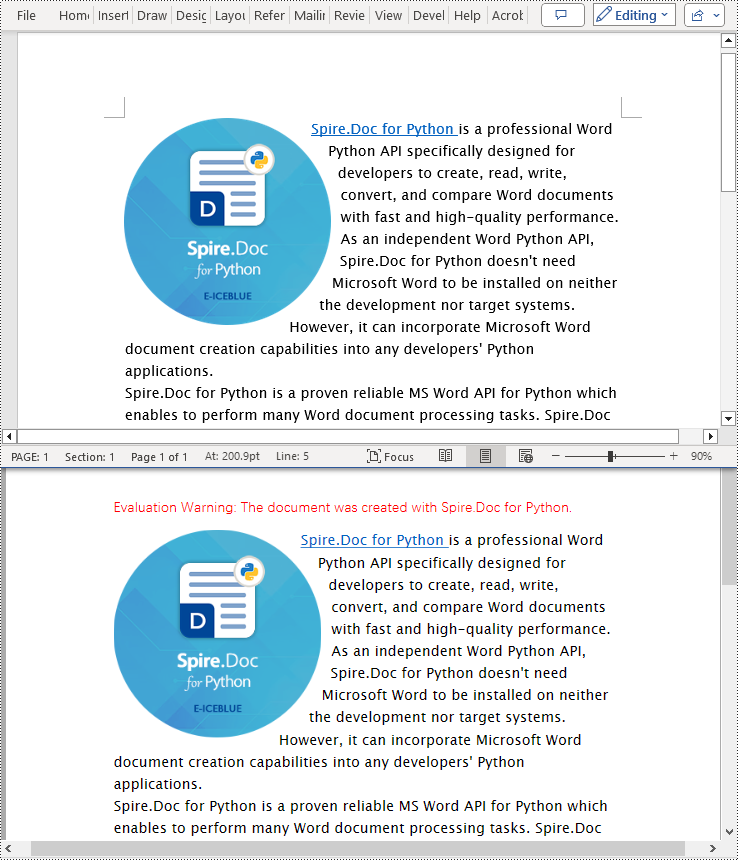
The Document.SaveToFile(filename:str, FileFormat.XPS) method provided by Spire.Doc for Python can convert a Word document to XPS format. The detailed steps are as follows:
- Create an object of the Document class.
- Use the Document.LoadFromFile() method to load the Word document.
- Use the Document.SaveToFile(filename:str, FileFormat.XPS) method to convert the Word document to an XPS document.
- Python
from spire.doc import *
from spire.doc.common import *

# Create a Document object
doc = Document()

# Load a Word document
doc.LoadFromFile("Sample.docx")

# Save the loaded document as an XPS document
doc.SaveToFile("Result.xps", FileFormat.XPS)

# Close the document object and release the resources occupied by the document object
doc.Close()
doc.Dispose()
Convert Word to PostScript in Python
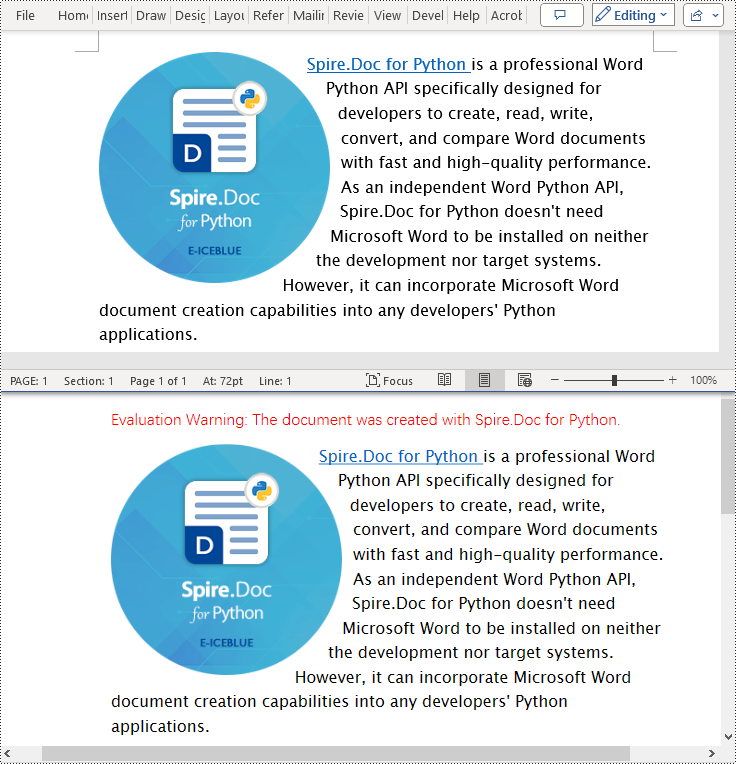
With Document.SaveToFile(filename:str, FileFormat.PostScript) method in Spire.Doc for Python, you can convert a Word document to PostScript format. The detailed steps are as follows:
- Create an object of the Document class.
- Use the Document.LoadFromFile() method to load the Word document.
- Use the Document.SaveToFile(filename:str, FileFormat.PostScript) method to convert the Word document to a PostScript document.
- Python
from spire.doc import *
from spire.doc.common import *

# Create a Document object
doc = Document()

# Load a Word document
doc.LoadFromFile("Sample.docx")

# # Save the loaded document as a PostScript document
doc.SaveToFile("Result.ps", FileFormat.PostScript)

# Close the document object and release the resources occupied by the document object
doc.Close()
doc.Dispose()
Convert Word to OFD in Python
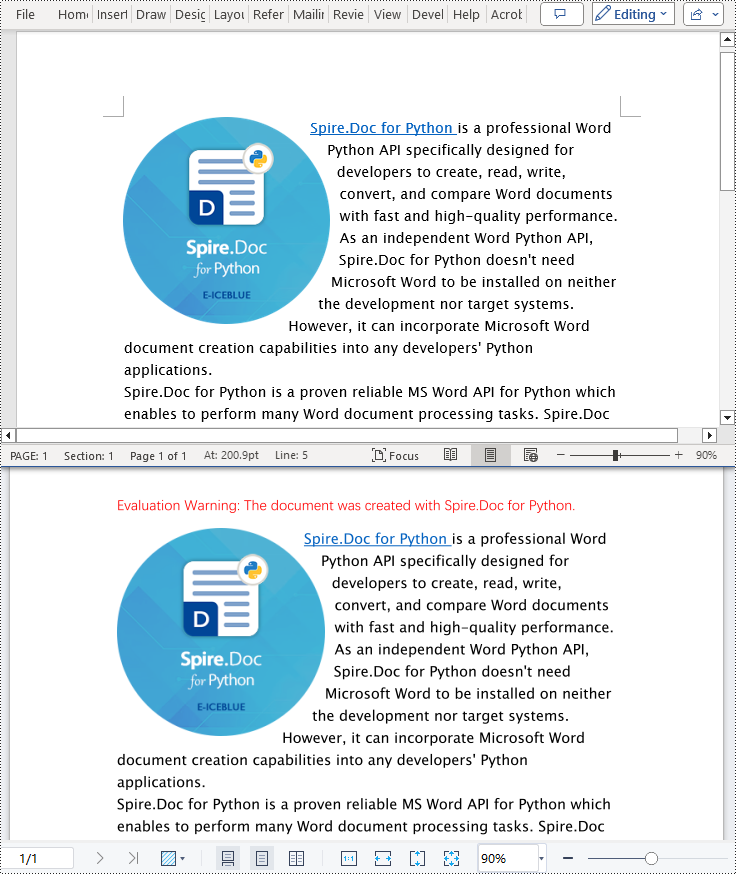
By utilizing the Document.SaveToFile() method in the Spire.Doc for Python library and specifying the file format as FileFormat.OFD, you can save a Word document as an OFD file format. The detailed steps are as follows:
- Create an object of the Document class.
- Use the Document.LoadFromFile() method to load the Word document.
- Use the Document.SaveToFile(filename:str, FileFormat.OFD) method to convert the Word document to an OFD document.
- Python
from spire.doc import *
from spire.doc.common import *

# Create a Document object
doc = Document()

# Load a Word document
doc.LoadFromFile("Sample.docx")

# Save the loaded document as an OFD document
doc.SaveToFile("Result.ofd", FileFormat.OFD)

# Close the document object and release the resources occupied by the document object
doc.Close()
doc.Dispose()
Get a Free License
To fully experience the capabilities of Spire.Doc for Python without any evaluation limitations, you can request a free 30-day trial license.
Read Word Document in C# .NET: Extract Text, Tables, Images
2024-02-29 01:18:43 Written by hayes Liu
Word documents (.doc and .docx) are widely used in business, education, and professional workflows for reports, contracts, manuals, and other essential content. As a C# developer, you may find the need to programmatically read these files to extract information, analyze content, and integrate document data into applications.
In this complete guide, we will delve into the process of reading Word documents in C#. We will explore various scenarios, including:
- Extracting text, paragraphs, and formatting details
- Retrieving images and structured table data
- Accessing comments and document metadata
- Reading headers and footers for comprehensive document analysis
By the end of this guide, you will have a solid understanding of how to efficiently parse Word documents in C#, allowing your applications to access and utilize document content with accuracy and ease.
Table of Contents
- Set Up Your Development Environment for Reading Word Documents in C#
- Load Word Document (.doc/.docx) in C#
- Read and Extract Content from Word Document in C#
- Advanced Tips and Best Practices for Reading Word Documents in C#
- Conclusion
- FAQs
Set Up Your Development Environment for Reading Word Documents in C#
Before you can read Word documents in C#, it’s crucial to ensure that your development environment is properly set up. This section outlines the necessary prerequisites and step-by-step installation instructions to get you ready for seamless Word document handling.
Prerequisites
- Development Environment: Ensure you have Visual Studio or another compatible C# IDE installed.
- .NET Requirement: Ensure you have .NET Framework or .NET Core installed.
- Library Requirement: Spire.Doc for .NET, a versatile library that allows developers to:
- Create Word documents from scratch
- Edit and format existing Word documents
- Read and extract text, tables, images, and other content programmatically
- Convert Word documents to PDF, HTML, and other formats
- Work independently without requiring Microsoft Word installation
Install Spire.Doc
To incorporate Spire.Doc into your C# project, follow these steps to install it via NuGet:
- Open your project in Visual Studio.
- Right-click on your project in the Solution Explorer and select Manage NuGet Packages.
- In the Browse tab, search for "Spire.Doc" and click Install.
Alternatively, you can use the Package Manager Console with the following command:
PM> Install-Package Spire.Doc
This installation adds the necessary references, enabling you to programmatically work with Word documents.
Load Word Document (.doc/.docx) in C#
To begin, you need to load a Word document into your project. The following example demonstrates how to load a .docx or .doc file in C#:
using Spire.Doc;
using Spire.Doc.Documents;
using System;

namespace LoadWordExample
{
    class Program
    {
        static void Main(string[] args)
        {
            // Specify the path of the Word document
            string filePath = @"C:\Documents\Sample.docx";

            // Create a Document object
            using (Document document = new Document())
            {
                // Load the Word .docx or .doc document
                document.LoadFromFile(filePath);
            }
        }
    }
}
This code loads a Word file from the specified path into a Document object, which is the entry point for accessing all document elements.
Read and Extract Content from Word Document in C#
After loading the Word document into a Document object, you can access its contents programmatically. This section covers various methods for extracting different types of content effectively.
Extract Text
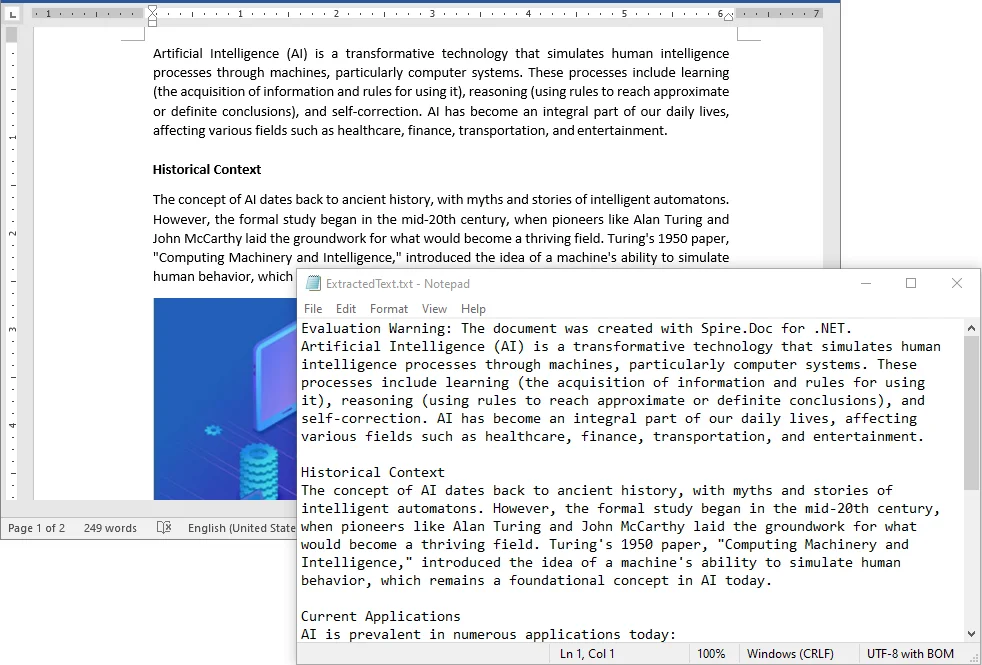
Extracting text is often the first step in reading Word documents. You can retrieve all text content using the built-in GetText() method:
using (StreamWriter writer = new StreamWriter("ExtractedText.txt", false, Encoding.UTF8))
{
    // Get all text from the document
    string allText = document.GetText();

    // Write the entire text to a file
    writer.Write(allText);
}
This method extracts all text, disregarding formatting and non-text elements like images.
Read Paragraphs and Formatting Information
When working with Word documents, it is often useful not only to access the text content of paragraphs but also to understand how each paragraph is formatted. This includes details such as alignment and spacing after the paragraph, which can affect layout and readability.
The following example demonstrates how to iterate through all paragraphs in a Word document and retrieve their text content and paragraph-level formatting in C#:
using (StreamWriter writer = new StreamWriter("Paragraphs.txt", false, Encoding.UTF8))
{
    // Loop through all sections
    foreach (Section section in document.Sections)
    {
        // Loop through all paragraphs in the section
        foreach (Paragraph paragraph in section.Paragraphs)
        {
            // Get paragraph alignment
            HorizontalAlignment alignment = paragraph.Format.HorizontalAlignment;

            // Get spacing after paragraph
            float afterSpacing = paragraph.Format.AfterSpacing;

            // Write paragraph formatting and text to the file
            writer.WriteLine($"[Alignment: {alignment}, AfterSpacing: {afterSpacing}]");
            writer.WriteLine(paragraph.Text);
            writer.WriteLine(); // Add empty line between paragraphs
        }
    }
}
This approach allows you to extract both the text and key paragraph formatting attributes, which can be useful for tasks such as document analysis, conditional processing, or preserving layout when exporting content.
Extract Images
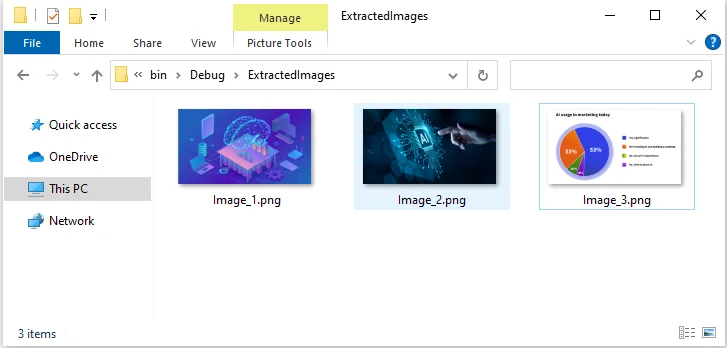
Images embedded within Word documents play a vital role in conveying information. To extract these images, you will examine each paragraph's content, identify images (typically represented as DocPicture objects), and save them for further use:
// Create the folder if it does not exist
string imageFolder = "ExtractedImages";
if (!Directory.Exists(imageFolder))
    Directory.CreateDirectory(imageFolder);

int imageIndex = 1;

// Loop through sections and paragraphs to find images
foreach (Section section in document.Sections)
{
    foreach (Paragraph paragraph in section.Paragraphs)
    {
        foreach (DocumentObject obj in paragraph.ChildObjects)
        {
            if (obj is DocPicture picture)
            {
                // Save each image as a separate PNG file
                string fileName = Path.Combine(imageFolder, $"Image_{imageIndex}.png");
                picture.Image.Save(fileName, System.Drawing.Imaging.ImageFormat.Png);
                imageIndex++;
            }
        }
    }
}
This code saves all images in the document as separate PNG files, with options to choose other formats like JPEG or BMP.
Extract Table Data
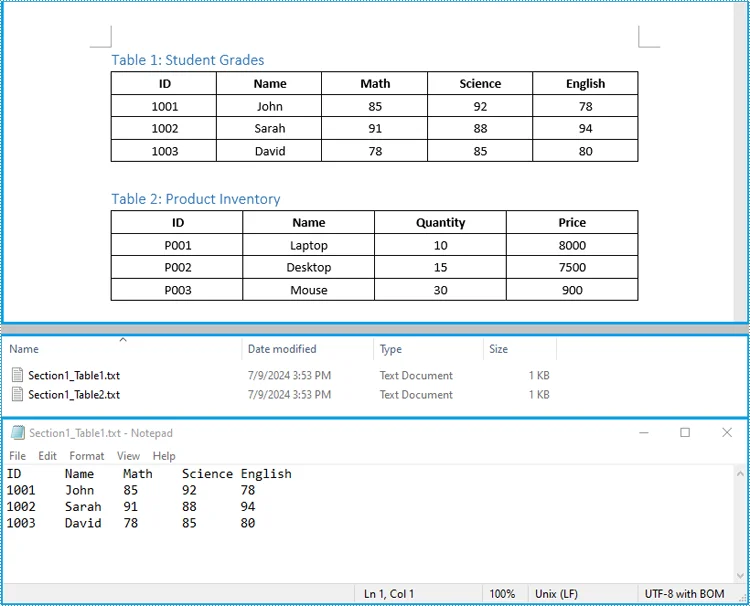
Tables are commonly used to organize structured data, such as financial reports or survey results. To access this data, iterate through the tables in each section and retrieve the content of individual cells:
// Create a folder to store tables
string tableDir = "Tables";
if (!Directory.Exists(tableDir))
    Directory.CreateDirectory(tableDir);

// Loop through each section
for (int sectionIndex = 0; sectionIndex < document.Sections.Count; sectionIndex++)
{
    Section section = document.Sections[sectionIndex];
    TableCollection tables = section.Tables;

    // Loop through all tables in the section
    for (int tableIndex = 0; tableIndex < tables.Count; tableIndex++)
    {
        ITable table = tables[tableIndex];
        string fileName = Path.Combine(tableDir, $"Section{sectionIndex + 1}_Table{tableIndex + 1}.txt");

        using (StreamWriter writer = new StreamWriter(fileName, false, Encoding.UTF8))
        {
            // Loop through each row
            for (int rowIndex = 0; rowIndex < table.Rows.Count; rowIndex++)
            {
                TableRow row = table.Rows[rowIndex];

                // Loop through each cell
                for (int cellIndex = 0; cellIndex < row.Cells.Count; cellIndex++)
                {
                    TableCell cell = row.Cells[cellIndex];

                    // Loop through each paragraph in the cell
                    for (int paraIndex = 0; paraIndex < cell.Paragraphs.Count; paraIndex++)
                    {
                        writer.Write(cell.Paragraphs[paraIndex].Text.Trim() + " ");
                    }

                    // Add tab between cells
                    if (cellIndex < row.Cells.Count - 1) writer.Write("\t");
                }

                // Add newline after each row
                writer.WriteLine();
            }
        }
    }
}
This method allows efficient extraction of structured data, making it ideal for generating reports or integrating content into databases.
Read Comments
Comments are valuable for collaboration and feedback within documents. Extracting them is crucial for auditing and understanding the document's revision history.
The Document object provides a Comments collection, which allows you to access all comments in a Word document. Each comment contains one or more paragraphs, and you can extract their text for further processing or save them into a file.
using (StreamWriter writer = new StreamWriter("Comments.txt", false, Encoding.UTF8))
{
    // Loop through all comments in the document
    foreach (Comment comment in document.Comments)
    {
        // Loop through each paragraph in the comment
        foreach (Paragraph p in comment.Body.Paragraphs)
        {
            writer.WriteLine(p.Text);
        }
        // Add empty line to separate different comments
        writer.WriteLine();
    }
}
This code retrieves the content of all comments and outputs it into a single text file.
Retrieve Document Metadata
Word documents contain metadata such as the title, author, and subject. These metadata items are stored as document properties, which can be accessed through the BuiltinDocumentProperties property of the Document object:
using (StreamWriter writer = new StreamWriter("Metadata.txt", false, Encoding.UTF8))
{
    // Write built-in document properties to file
    writer.WriteLine("Title: " + document.BuiltinDocumentProperties.Title);
    writer.WriteLine("Author: " + document.BuiltinDocumentProperties.Author);
    writer.WriteLine("Subject: " + document.BuiltinDocumentProperties.Subject);
}
Read Headers and Footers
Headers and footers frequently contain essential content like page numbers and titles. To programmatically access this information, iterate through each section's header and footer paragraphs and retrieve the text of each paragraph:
using (StreamWriter writer = new StreamWriter("HeadersFooters.txt", false, Encoding.UTF8))
{
    // Loop through all sections
    foreach (Section section in document.Sections)
    {
        // Write header paragraphs
        foreach (Paragraph headerParagraph in section.HeadersFooters.Header.Paragraphs)
        {
            writer.WriteLine("Header: " + headerParagraph.Text);
        }

        // Write footer paragraphs
        foreach (Paragraph footerParagraph in section.HeadersFooters.Footer.Paragraphs)
        {
            writer.WriteLine("Footer: " + footerParagraph.Text);
        }
    }
}
This method ensures that all recurring content is accurately captured during document processing.
Advanced Tips and Best Practices for Reading Word Documents in C#
To get the most out of programmatically reading Word documents, following these tips can help improve efficiency, reliability, and code maintainability:
- Use using Statements: Always wrap Document objects in using to ensure proper memory management.
- Check for Null or Empty Sections: Prevent errors by verifying sections, paragraphs, tables, or images exist before accessing them.
- Batch Reading Multiple Documents: Loop through a folder of Word files and apply the same extraction logic to each file. This helps automate workflows and consolidate extracted content efficiently.
Conclusion
Efficiently reading Word documents programmatically in C# involves handling various content types. With the techniques outlined in this guide, developers can:
- Load Word documents (.doc and .docx) with ease.
- Extract text, paragraphs, and formatting details for thorough analysis.
- Retrieve images, structured table data, and comments.
- Access headers, footers, and document metadata for complete insights.
FAQs
Q1: Can I read Word documents without installing Microsoft Word?
A1: Yes, libraries like Spire.Doc enable you to read and process Word files without requiring Microsoft Word installation.
Q2: Does this support both .doc and .docx formats?
A2: Absolutely, all methods discussed in this guide work seamlessly with both legacy (.doc) and modern (.docx) Word files.
Q3: Can I extract only specific sections of a document?
A3: Yes, by iterating through sections and paragraphs, you can selectively filter and extract the desired content.
